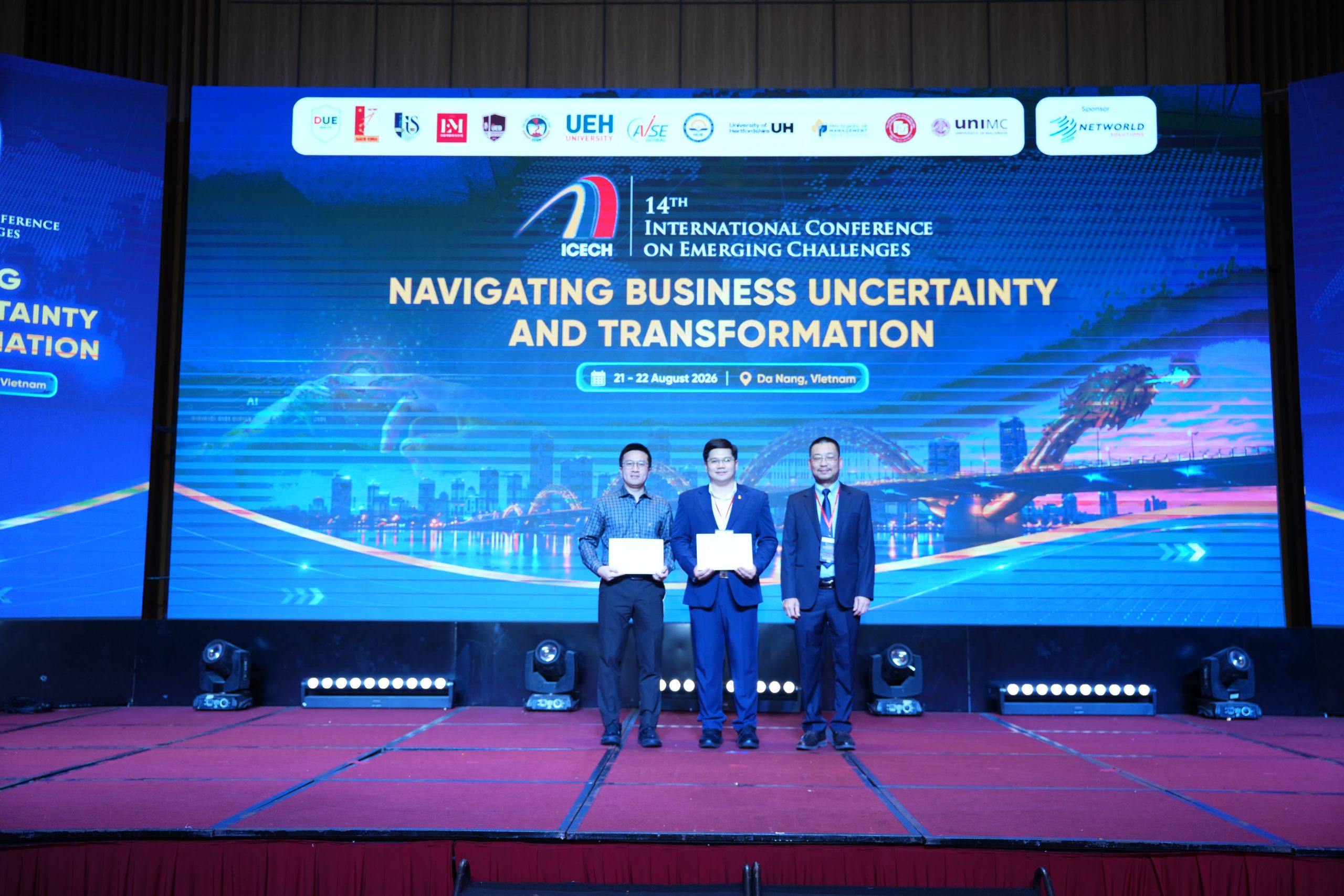
Dr. Nguyen Ngoc Anh, a lecturer at the Faculty of Economics and Management, VNU International School – Vietnam National University, Hanoi (VNU-IS), has won the “Best Paper Award” at the 14th International Conference on Emerging Challenges (ICECH 2026).
Amid the ongoing race for digital transformation, many businesses are turning to Big Data Analytics and Cloud Computing (BDAC) in the expectation that better use of data will lead to greater innovation. Drawing on the dynamic capability perspective, Dr. Nguyen Ngoc Anh’s research explores a compelling question: What happens when businesses are able to identify opportunities faster, but are unable to change quickly enough to capitalize on them?
The research team surveyed senior executives, supply chain managers, and digital transformation managers from manufacturing and logistics companies in Vietnam. The findings reveal a notable paradox: the adoption of Big Data Analytics and Cloud Computing enables firms to identify opportunities more rapidly and effectively, but product innovation depends more heavily on their ability to change and reconfigure the organization.
Dr. Nguyen Ngoc Anh receives the Best Paper Award at ICECH 2026.
More specifically, BDAC has its strongest impact on sensing capability – the ability to identify market needs, technological changes, and supply chain risks. It also enhances firms’ capabilities to seize opportunities and transform their organizations. However, when it comes to product innovation, the pattern is reversed: transforming capability emerges as the strongest driver, significantly outweighing the ability to sense opportunities.
This finding carries important implications for managers. First, businesses may become highly capable of “knowing what is happening” while remaining slow to “change and do something differently.” Second, technology can provide information and insights, but whether those insights are translated into new products depends on the organization itself.
Another notable finding is that BDAC has a stronger effect on organizational reconfiguration when technological turbulence is high. By contrast, competitive intensity does not significantly alter this relationship. In other words, intense competition does not automatically mean that firms will make better use of BDAC. The greater challenge may lie in an environment where technology is changing so rapidly that existing structures and established ways of working become obsolete.
Rather than simply asking, “Have we invested enough in technology?”, managers need to ask a more fundamental question: “Is our organization agile enough for technology to create real value?”
The study points to three key priorities. First, businesses should continue investing in Big Data Analytics and Cloud Computing capabilities, but view them as an enabling foundation rather than an end in themselves. Second, they need to strengthen their transforming capabilities, including process restructuring, resource reallocation, change management, and the development of a data-driven decision-making culture. Third, particularly in highly turbulent technological environments, firms should prioritize organizational reconfiguration rather than simply increasing analytical capabilities or accumulating more data.
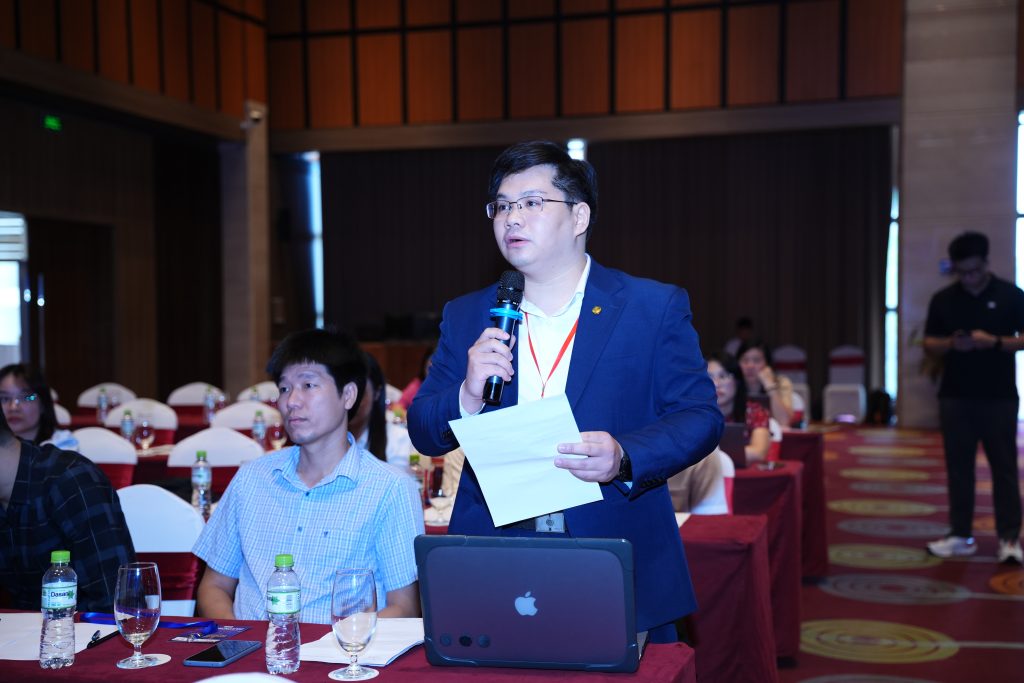
Dr. Nguyen Ngoc Anh exchanges views during a parallel session at the conference.
🌐 About ICECH 2026
ICECH 2026 attracted nearly 200 delegates, participating both in person and online. In addition to researchers from Vietnam, the conference welcomed scholars from countries and territories including the United Kingdom, Italy, Australia, France, the United States, Indonesia, South Korea, and Taiwan.
Following a large number of submissions, the Organizing Committee selected more than 120 papers for presentation in the conference’s official sessions, alongside three keynote research presentations by leading scholars.
At the conference, 28 lecturers and more than 10 students from VNU International School presented their research across a wide range of topics, including Strategic Transformation Management, Twin Transformation, Digital Technologies for Management, Green Supply Chain Management, Smart Finance, and other emerging areas.
The research presented by VNU International School’s lecturers and students attracted considerable interest from conference participants, generating constructive discussions and exchanges that provided valuable feedback for the researchers to further develop their work.
The ICECH 2026 sessions featured research addressing issues with a direct impact on contemporary business, including artificial intelligence applications, digital transformation management, innovation and creativity, digital finance, ESG practices, sustainable supply chain development, and green consumer behavior.
Beyond presenting research findings, the conference served as an important forum for scholars from Vietnam and abroad to expand professional networks, exchange research methodologies, and explore new opportunities for research collaboration. It also fostered an open and highly practice-oriented academic environment, enabling lecturers, researchers, and students to engage with emerging research trends and new business practices being adopted by enterprises.