The presentation introduced a systematic framework for robotizing complex welding operations — tasks that traditionally demand the expertise and real-time adaptive control of skilled welders — by integrating learning from human demonstrations, physics-based modelling and artificial intelligence.
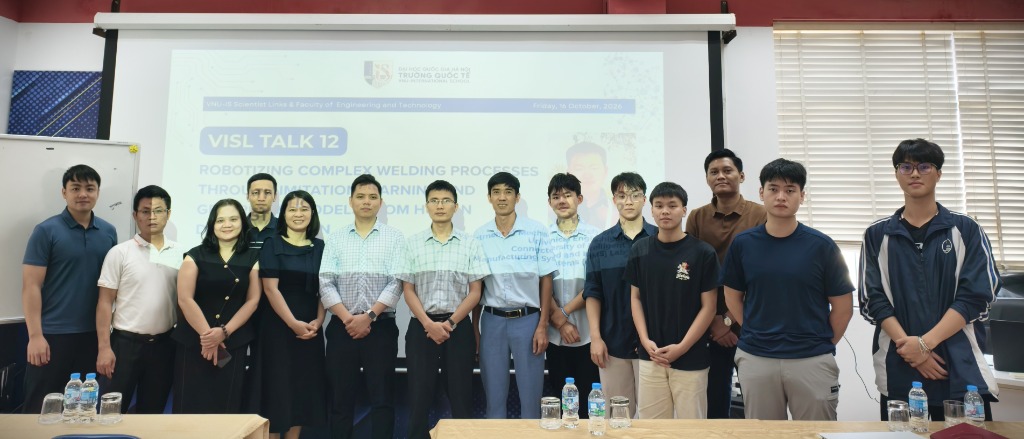
On 16 October 2026, the Department of Engineering and Technology, in collaboration with the Scientists’ Club of VNU International School – Vietnam National University, Hanoi (VNU-IS), held a scientific seminar entitled “Robotizing Complex Welding Processes through Imitation Learning and Generative Models from Human Demonstration Data.” The guest speaker was Dr Yue Cao, a faculty member at the University of Michigan, United States.
Opening the talk, Dr Yue Cao highlighted the core challenge facing the field: arc welding processes require real-time adaptive control that current robotic systems cannot yet perform autonomously. To address this problem, the speaker developed a systematic framework for robotizing complex welding operations, built on three pillars: learning from human demonstrations, physics-based reconstruction and model-based imitation learning.
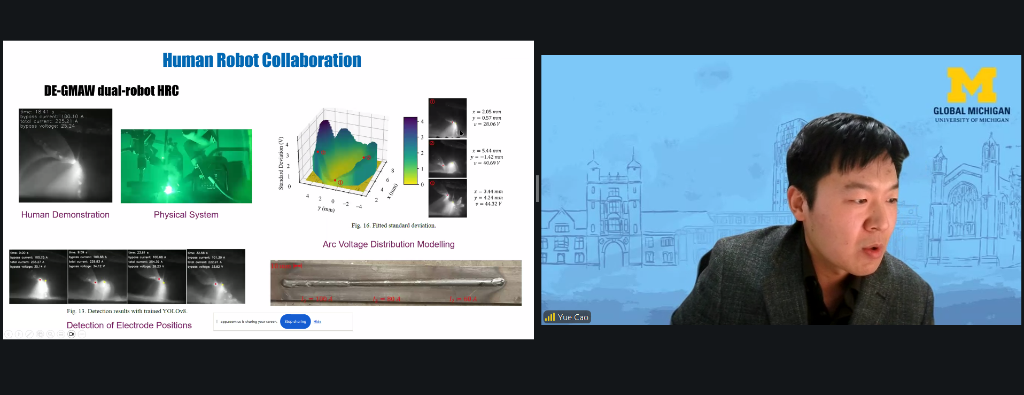
Specifically, the study established human-robot collaborative systems for both gas tungsten arc welding (GTAW/TIG welding) and double-electrode gas metal arc welding (DE-GMAW). These systems combine teleoperated robotic control with virtual-reality interfaces, enabling the capture of high-quality demonstrations from skilled welders — thereby generating the input data from which robots can “learn” to perform complex operations.
One of the standout contributions presented by Dr Yue Cao was a physics-informed neural network framework capable of reconstructing the full flow field of a molten weld pool from high-speed images. This method extends our understanding of the welding process well beyond what sensors can observe directly. The study combines teleoperated robotic control and virtual-reality interfaces to capture high-quality demonstrations from skilled welders, and applies physics-informed neural networks and generative models to reconstruct flow fields and achieve robust real-time state estimation.
In addition, the research developed generative models that learn compact and temporally consistent representations of welding-process dynamics. A hybrid latent variational autoencoder (hybrid latent VAE) was employed for weld-pool prediction and visualisation, while a dynamic variational autoencoder integrated with particle filtering (dynamic VAE with particle filtering) enabled robust state estimation. These models simultaneously enhance human control efficiency and improve the system’s ability to interpret process states.
Dr Yue Cao also presented a model-based imitation learning approach that combines adversarial imitation learning with neural ordinary differential equation (neural ODE) dynamics. This method makes it possible to extract and optimise the accumulated expertise of skilled welders for the automated control of GTAW processes.
Furthermore, a bidirectional multi-rate control architecture was developed to extend the model to humanoid robotic platforms that require high-level balance, with applications in precision manufacturing. Taken together, these contributions establish a modular and transferable pipeline — from capturing human demonstrations to achieving autonomous robotic welding.
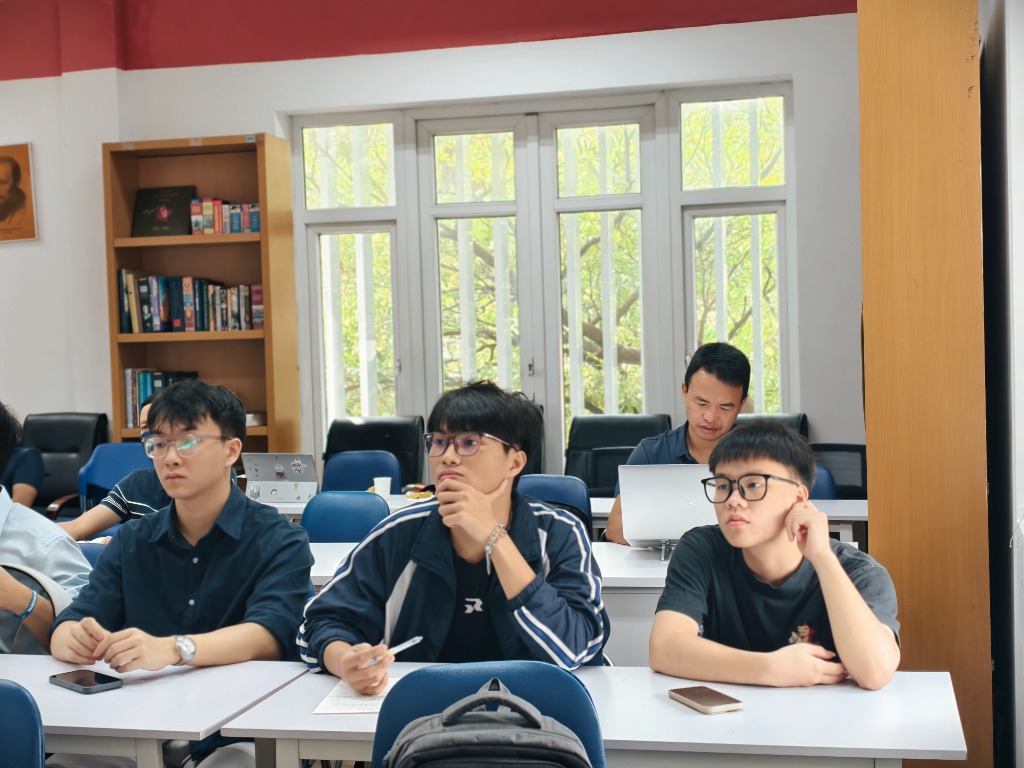
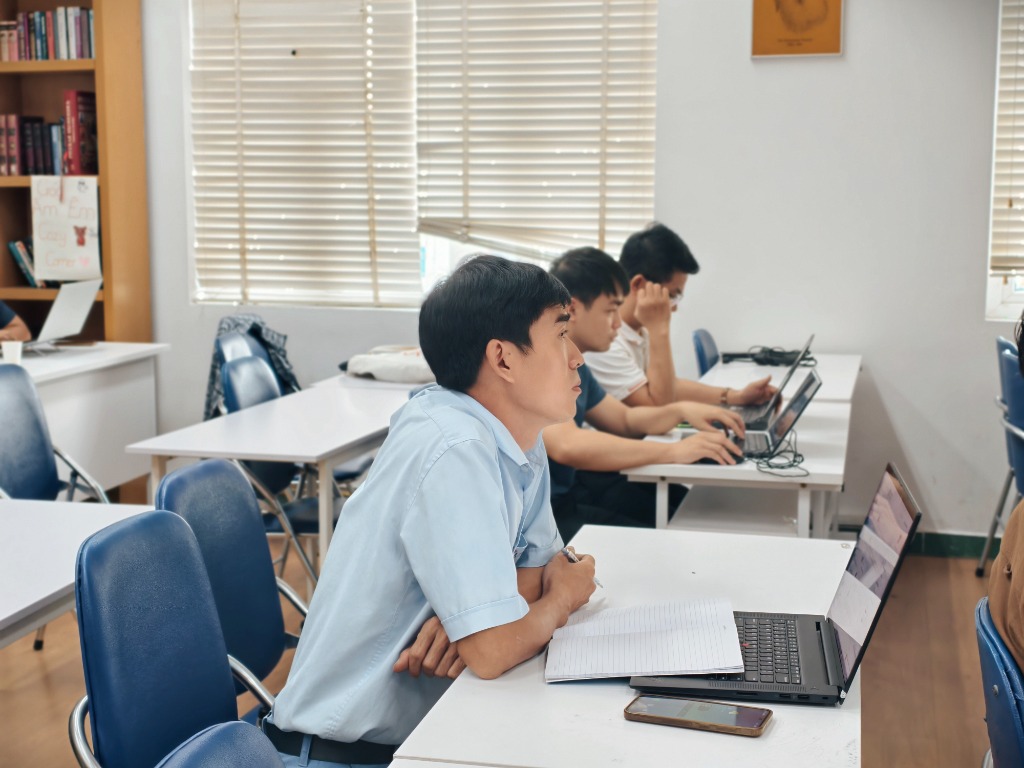
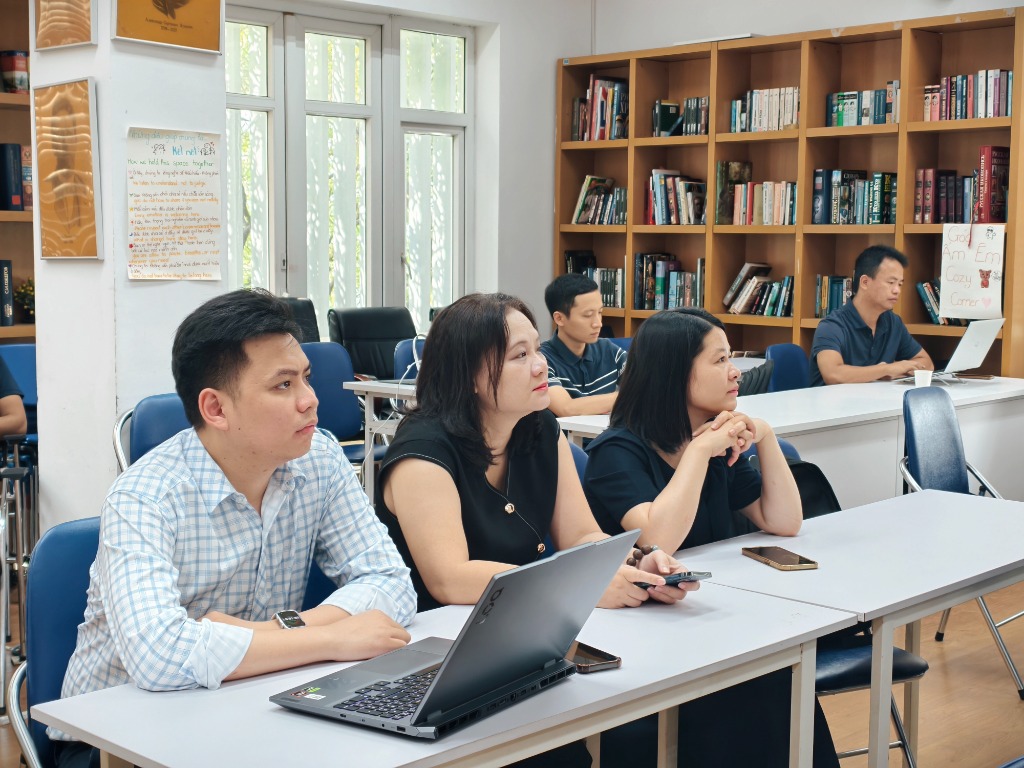
Scientific seminars featuring international speakers are among the academic exchange activities organised by the School’s specialised departments and the Scientists’ Club. These events provide faculty members, doctoral researchers and students at VNU-IS with opportunities to engage with cutting-edge global research trends, while opening up prospects for research collaboration between the School and international universities.
The regular seminar series at VNU International School – Vietnam National University, Hanoi continues to serve as a vital bridge of knowledge, fostering a vibrant academic atmosphere, inspiring creativity and building a worldwide network of experts.