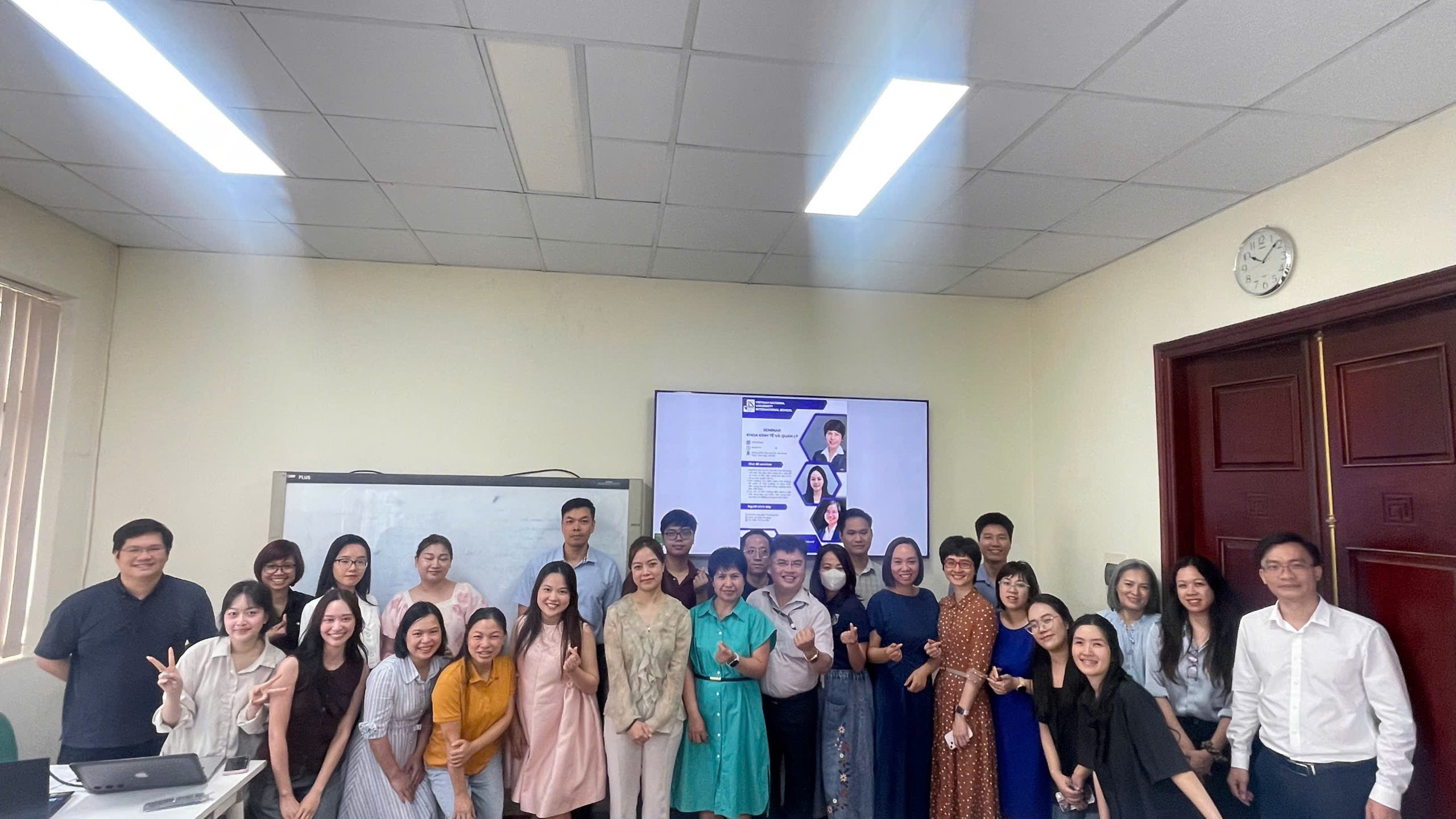
On 2 July 2026, the Faculty of Economics and Management, International School – Vietnam National University, Hanoi, successfully organized its monthly research seminar with the participation of faculty members, doctoral candidates, and researchers. The seminar was held as part of the University’s commitment to innovating teaching activities, strengthening academic collaboration between lecturers and doctoral students, and expanding research support for doctoral candidates.
Faculty leaders, lecturers, doctoral candidates, and researchers pose for a group photo.
The seminar served as an academic platform for participants to present research findings, exchange scholarly perspectives, and discuss emerging issues in sustainable development, digital transformation, and innovation management.
Environmental Auditing – A Lever for Environmental Governance and Sustainable Development
The first presentation, delivered by PhD Candidate Le Hoai Phuong, examined the impact of environmental auditing on environmental governance and sustainable development in industrial parks in Northern Vietnam. Drawing upon Institutional Theory and the Resource-Based View (RBV), the study analyzed survey data from 301 enterprises using the PLS-SEM approach.
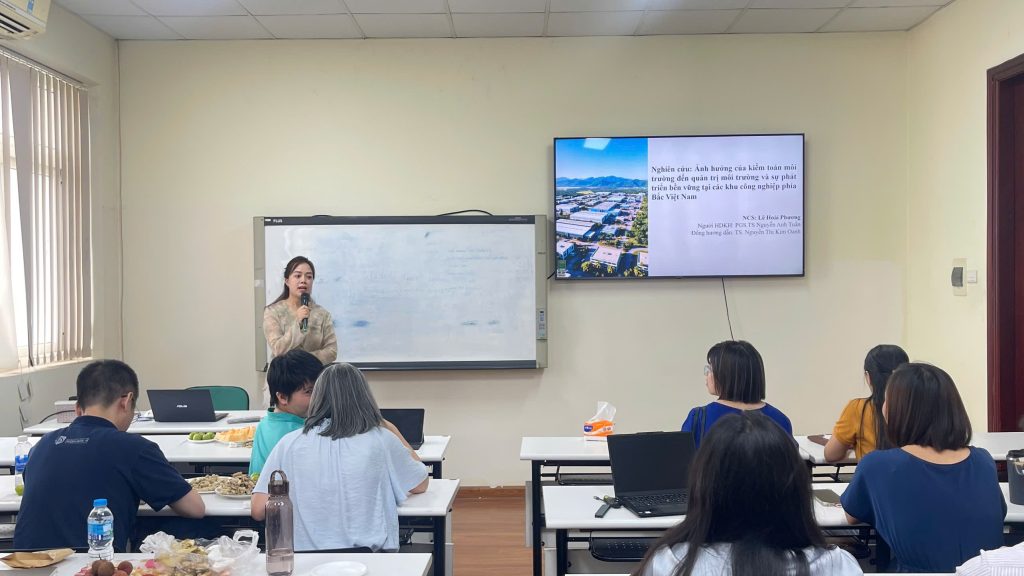
PhD Candidate Le Hoai Phuong presents research on the impact of environmental auditing on environmental governance and sustainable development in industrial parks in Northern Vietnam.
The findings revealed that government environmental audits significantly enhance top management commitment and environmental practices but do not directly improve environmental performance. Instead, environmental performance is achieved through stronger managerial commitment and the implementation of effective environmental practices. In addition, resource availability strengthens the relationship between environmental practices and environmental performance, highlighting the importance of organizational capabilities in achieving sustainable outcomes.
Digital Culture and Psychological Empowerment – Keys to Unleashing Innovative Work Behavior
The second presentation, by Dr. Tran Thi Thu Hai, focused on the role of digital culture in the relationship between digital leadership and innovative work behavior from the perspective of psychological empowerment. Based on Upper Echelons Theory, the proposed framework explains how digital leadership promotes employees’ innovative work behavior through the development of a digital culture while psychological empowerment strengthens these relationships.
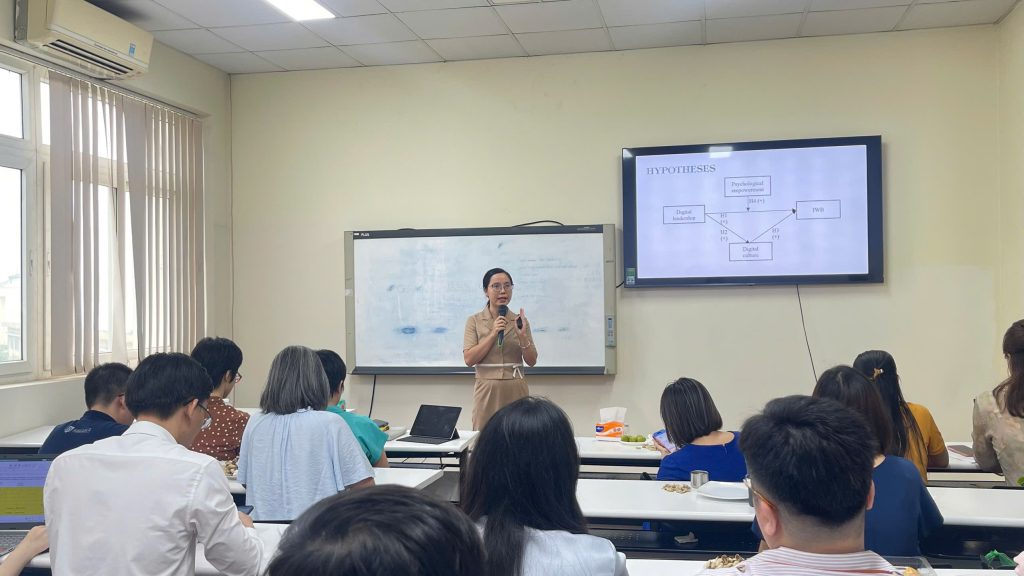
Dr. Tran Thi Thu Hai presents her research on the role of digital culture and psychological empowerment in the relationship between digital leadership and employees’ innovative work behavior.
The study provides evidence that digital leadership not only directly encourages innovative behavior but also indirectly influences innovation by fostering a supportive digital culture. Furthermore, employees with higher levels of psychological empowerment are more likely to translate digital leadership and organizational culture into innovative workplace behaviors.
Intrinsic Motivation and Knowledge Sharing – The Foundation for Employee Innovation
The final presentation, delivered by Associate Professor Nguyen Phuong Mai, explored the determinants of innovative work behavior among employees in Vietnam’s service sector. Grounded in the Component Theory of Creativity and Innovation and the Knowledge-Based View, the research surveyed 385 service employees and employed Structural Equation Modeling (SEM) for data analysis.
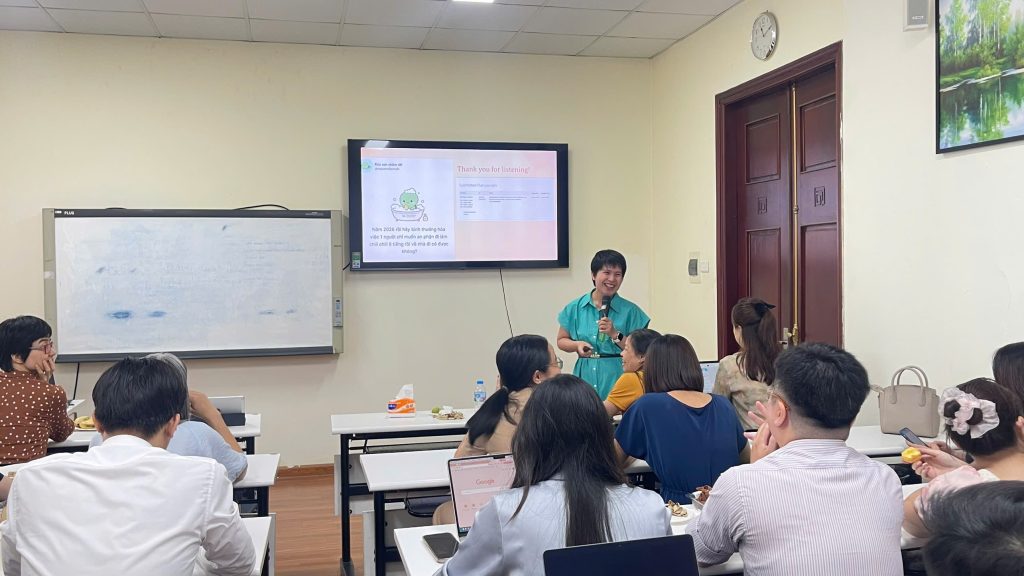
Associate Professor Dr. Nguyen Phuong Mai presents research on the determinants of employees’ innovative work behavior in Vietnam’s service sector.
The results indicate that intrinsic motivation and knowledge sharing are the two strongest predictors of innovative work behavior, with intrinsic motivation demonstrating the greatest influence. In contrast, empowering leadership, organizational encouragement, and psychological safety did not show statistically significant direct effects in the research context. These findings provide valuable insights into the drivers of employee innovation within Vietnam’s rapidly growing service industry.
Following each presentation, participants actively engaged in discussions on theoretical contributions, research methodology, managerial implications, and potential directions for future studies. The lively exchange of ideas reflected the Faculty’s commitment to fostering a vibrant academic environment and strengthening research capacity among faculty members and doctoral candidates.
The seminar reaffirms the Faculty of Economics and Management’s ongoing commitment to promoting research excellence, enhancing teaching quality, and contributing to sustainable academic development and international integration.
Nguyen Ngoc Anh
Faculty of Economics and Management